

On this page, I offer a detailed presentation of Californian massage, organized into different sections to make it easy to understand. It begins with an overview of its origins and main influences, followed by a presentation of its fundamental principles, its key characteristics, and how these are applied in practice. The page then introduces the specific techniques of Californian massage, before outlining the typical structure of a session.
Introduction
Origin : context of the emergence of Californian massage
The 1960s. A shift in the way care and the individual are understood
Californian massage emerged in the late 1960s in the United States, at the Esalen Institute in California. This period was marked by a questioning of traditional approaches to medical care and psychotherapy, mainly focused on illness and symptoms, leaving little room for the bodily, emotional, and subjective experience of individuals.
In this context, the "New Age" movement developed. The term refers to a range of body-based practices and philosophical reflections, sometimes with a spiritual dimension, proposing a holistic approach to the individual.
This approach emerged in response to aspects that were less considered in traditional medicine and psychology. The Esalen Institute is sometimes associated with this movement, without being limited to it.
Esalen. An interdisciplinary space for exploration
During this period, the Esalen Institute developed as a place of experimentation and research grounded in a humanistic philosophy. The work carried out there followed an interdisciplinary approach. Different types of massage were explored, along with Gestalt therapy and various forms of bodywork, some inspired by Asian practices such as meditation and yoga. It was within this experimental setting that the first principles and early forms of Californian massage took shape.
In the 1970s, this practice spread to Europe while maintaining its foundations. It was then used in different ways, either as a practice in its own right or integrated into certain psychotherapeutic approaches when bodywork was part of the process. Today, the Esalen Institute continues its work of research and transmission around the body and the therapeutic relationship.
Main influences of Californian massage
Humanistic relational approach
The humanistic relational approach originates in humanistic psychology, developed in the United States in the mid-20th century, notably through the work of Carl Rogers. It is described as "person-centered" because it considers the individual as a whole, rather than focusing only on difficulties or on what is expressed verbally. It is based on the idea that each person has internal resources to face what they are going through. This approach is characterized by a quality of listening and a congruent presence, where the person is welcomed as they are, in their experience, without interpretation or imposed direction. In this perspective, the role of support is not to create change, but to create a safe relational environment in which these resources can emerge.
Expression of this influence in the massage
The humanistic relational approach is reflected in Californian massage through the way the practitioner relates to the person receiving the session. It shapes the quality of presence during the session, the attention given to what arises, and the absence of any corrective or interpretative intention. The relational setting is designed to provide a safe and respectful environment, allowing the person’s experience to unfold freely.
Asian references in a holistic view of the body
Certain Asian traditions of thought and practice, particularly from India and China, reflect a holistic view of the person, in which the body, emotions, and thought processes are closely connected. This perspective is illustrated, for example, by practices such as yoga, tai chi, and qi gong, which emphasize slow and continuous movements supported by the breath.
This approach supports a stable attention to the ongoing experience, without seeking performance or any specific effect.
Expression of this influence in the massage
Asian influences related to a holistic view of the body mainly shape the overall flow of the session. They are reflected in the choice of a slow and modulated rhythm, in the attention given to the breath, and in the continuity of movements, which structure the session without interruption. This influence concerns less the touch itself than the way the session unfolds within a calm and stable pace, not oriented toward performance.
Touch repertoire derived from Swedish massage
Swedish massage is a Western form of massage developed in the 19th century in Europe, notably based on the work of Pehr Henrik Ling. It relies on a structured approach to touch, grounded in a precise knowledge of anatomy. It involves a range of techniques applied to muscles and joints, such as effleurage, gliding strokes, kneading, friction, and percussion. These techniques act locally on muscular and joint tissues, depending on the areas being worked on.
Expression of this influence in the massage
The touch techniques derived from Swedish massage form a technical foundation of Californian massage. They provide a set of structured manual movements, based on an anatomical understanding of the body, applied to muscles and joints. These techniques support the bodywork without forming a rigid or exclusive protocol.


Fundamental principle
Supporting the person as a whole through massage, within a safe setting
A principle refers to the basic idea from which a practice is developed and structured. In Californian massage, this principle consists of offering body-based support that considers the person as a whole, within a safe setting. In this perspective, the person as a whole refers to everything involved in the massage experience, namely:
The body : the place of sensations, tensions, and bodily experience.
Emotions : as they arise and evolve during the experience.
Thought : understood as mental activity as it accompanies bodily and emotional experience.
Characteristics of Californian massage
Introduction
A characteristic describes the general form something takes as a whole..
Full-body enveloping massage
In practice, the practitioner works on the whole body in a continuous way. The touch does not divide the body into isolated areas. Within this movement, attention may focus more specifically on certain areas when needed, before returning to the overall flow of the massage.
Fluidity of touch
In practice, the practitioner performs movements and sequences of touch without interruption or abrupt gestures. The touch unfolds in a fluid manner throughout the session.
Slow pacing
In practice, the session follows a slow rhythm. This pace is present in the movements, in the quality of touch, and in the breathing of both the practitioner and the person receiving the massage. Variations may occur at times, without altering this overall pace.
Predominantly broad movements
In practice, the movements are generally broad. Their range may occasionally become more contained, depending on what arises during the session.
Soft and adaptable touch
In practice, the touch is applied gently, without being intrusive. The pressure varies throughout the session, ranging from very light contact to more sustained pressure when appropriate.
Attunement between the practitioner and the client
In Californian massage, a gradual attunement may develop between the practitioner and the person receiving the massage. The practitioner adjusts to the person’s breathing rhythm, and at times to other perceived bodily rhythms, such as the heartbeat. This attunement can emerge from continuous contact and the quality of the practitioner’s presence.
Safe relational setting
In Californian massage, the entire practice takes place within a safe relational setting. The way the practitioner engages in the relationship, the quality of touch, and the consistency of the session all contribute to creating a stable and predictable environment in which the person can feel at ease.
Practitioner’s adjustment
In Californian massage, the practice relies on the practitioner’s ongoing ability to adjust. This adjustment is based on attention to the situation, allowing the massage to unfold in a way that is adapted throughout the session. It also involves a careful listening to the body’s responses, in order to adapt the touch according to the person’s needs.


Techniques
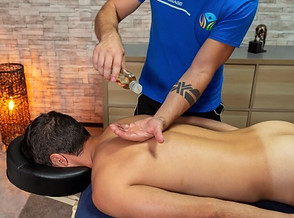
The techniques of Californian massage are mainly rooted in the Western tradition of massage and are particularly influenced by Swedish massage. They rely exclusively on manual touch and are characterized by an overall slow rhythm, which may vary throughout the session. The pressure is adjustable, ranging from light contact to deeper pressure, depending on the areas being worked on and what arises during the massage. I have created a dedicated page where I present the most commonly used techniques in Californian massage in detail. To access it, please click on the tab below "Californian massage techniques".
"Typical structure" of a Californian massage session
Californian massage is not based on a strict protocol or on a fixed sequence of steps to be followed in a linear way. I have created a page where I present a "typical structure" that offers a general reference for how a session unfolds, outlining the main stages that usually shape it, from the massage of the back of the body to the front. To access this page, you can click on the tab below "Typical structure of Californian massage".
Additional resources : scientific articles
Californian massage is a practice whose transmission has developed mainly outside the academic field, through professional training and practitioner-based literature. As a result, there is limited scientific research specifically focused on this practice. The articles presented here do not address Californian massage directly. They explore more broadly the physiological effects observed when a person receives a massage, particularly in relation to blood circulation, the autonomic nervous system, the immune system, and stress responses. To read them in full, simply click on the button below.
Additional resources : videos
I share here two Californian massage courses by Hakim Boukhezoula, hosted on YouTube and sourced from reliable materials. These videos offer a concrete representation of Californian massage, showing its principles, main characteristics, and how they are applied in practice. They correspond to a level 1 course and a level 2 course. To watch them, simply click on the buttons below.


